Do you want to increase your orders by 84 % as our client prvni-lekarna.cz? More than 50% of our customers get a 10% increase in sales using our platform and best practices, some of them achieve even 30% revenue growth such as Krmeni.cz.
For many digital marketers, the funnel ends with converting a lead into a customer and they invest most of the time and resources to chase after leads. After their first purchase, they just start sending a general newsletter and focus on attracting new customers. But every existing customer can become a long-term client, with significantly lower costs than attracting a new one. Furthermore, repeat customers bring higher average order value compared to first-time customers.
How to measure your success in converting a first-time customer?
There are several metrics that you may find. Repeat purchase rate, re-order rate or customer retention rate but they all describe simple facts if your customers return to purchase more goods or services from you. Depending on your segment, your repeat purchase rate may vary but you may consider a repeat purchase rate from 20-40% go
Understand your convertion to second purchase rate
You can easily get your actual open rate in Samba business insights. Business insights tells you not only the actual rate of repeated orders made by your customers, but the average number of days between them and also trends showing how successful you are with repeated orders.
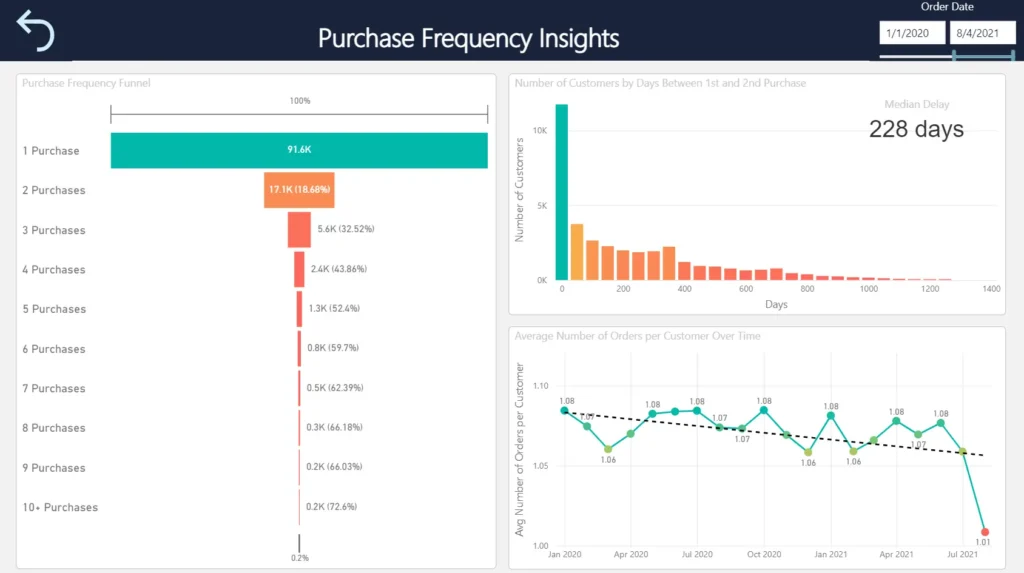
For example this client is having only 18.6% of success rate for second purchases. Second purchase is made once per 228 days and in general the rate of repeated purchase is decreasing over time.
How to increase second purchase rates
Successful strategy for increasing second purchases is different for every ecommerce store and usually depends on the product category purchased in the first order.
Let’s look at our client mentioned above. In this specific case, our general suggestion would be:
- Find top categories with highest business potential for repeated purchase rate
- Discover within your data what does your customers bought for second time
- Build flow automation campaigns targeting first time buyers in these categories
- Build generic flow automation with personalized suggestions for the rest
- Analyze if your strategy works
Find top categories with highest business potential for repeated purchase rate
To find categories on your ecommerce, where your customers purchase most for the second time isn’t always as straightforward as it might sound. Great helper in this situation is again Samba Business Insights.
First, look for the product category that earns you the most revenue and start over them with second purchase analysis.
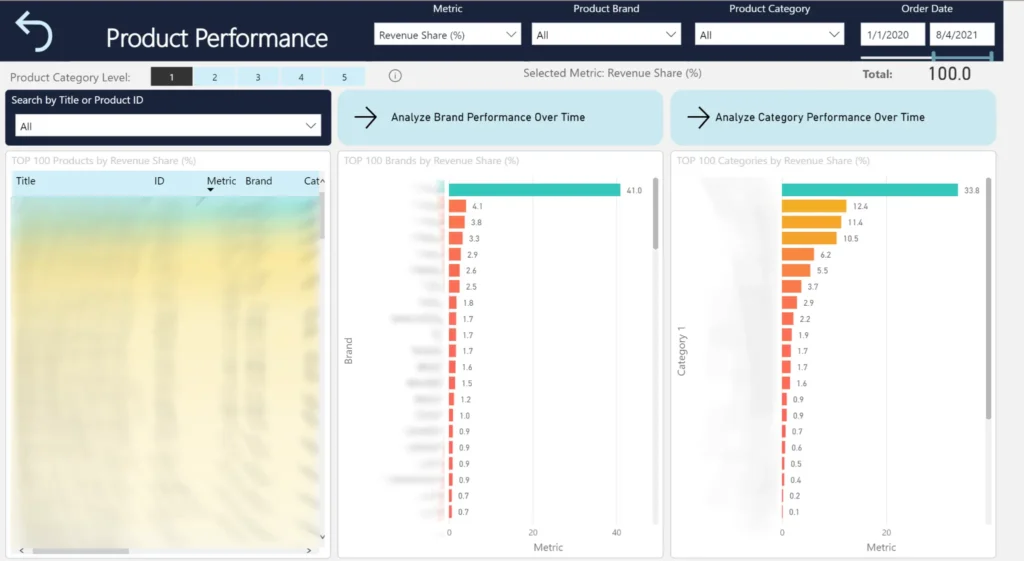
Our client is having one product category really dominant and the first four product categories earn him almost 70% of his yearly revenue.
Tip: If you don’t have Samba business insights available, you can get quick information about your top performing categories in Samba directly – Audience and filters, recently purchased products. In this special, compound filter, you can choose your product category, filter all the customers who made purchases and see overall revenue they bring you.
Discover within your data what does your customers bought for second time
Sometimes, the top performing product categories aren’t the best one to start with. That’s why you need to know how many customers repeated their purchase in a specific product category and at the same time what revenue it delivers to your business.
The easiest way to get this information in Samba, is again to use recently purchased products segmentation, but with slightly different conditions.
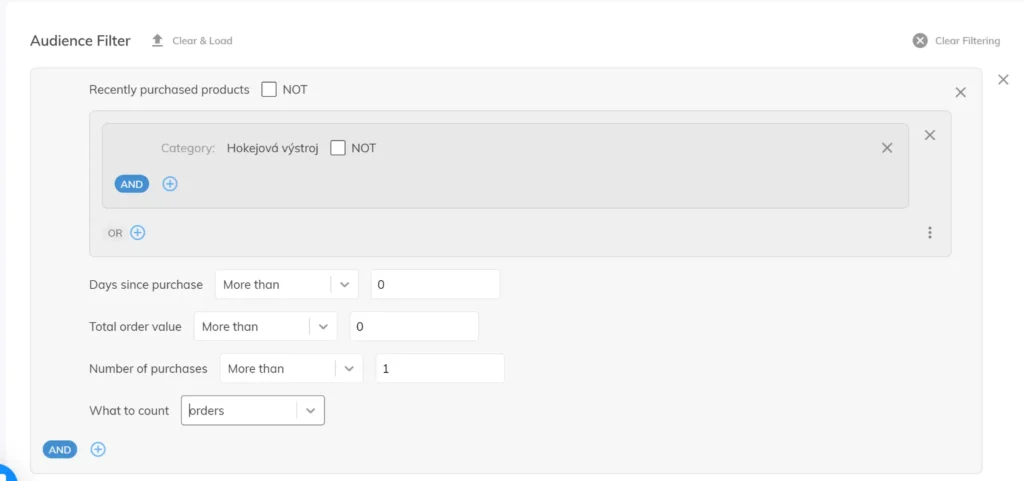
This filter will select all your customers, who did more than 1 order in the specified category.
Is important to select the analyzed product category, set the number of purchases for more than 1 and change “what to count” to orders. And you can immediately see the overall revenue they generated to your business.
For example, our client will discover that revenue generated from a customer’s second purchase is almost the same in the second product category, despite the fact that overall revenue is three times bigger in the first category. That might signal an opportunity to significantly increase second purchase in the first category, but with respect to maximizing earnings over time it’s better to develop first flow automation on the most promising product category – the second one and after that, return back to finish automation in the first category.
Build flow automation campaigns targeting first time buyers in these categories
Let’s say the second category in our example is the category with iPhones. You can again look into Samba and find what is the top selling products from iPhones category. Most probably you will find that the most selling product is a mobile phone with a cover and that 15% of your customers also bought wireless headphones in first order.
This is a great business insight which can be used as hypothesis for our first flow automation campaign:
“For all the customers who bought an iPhone, send after 14 days an upsell newsletter and offer an earpod together with other personalized products”.
Let’s stop here for a while – how do we discover 14 days is the best time to sell an upsell offer? There are two ways – first, most commonly used – you will guess it on your own. You like the number 14 more than 13 and less than 15 🙂
Second way is to use Samba business insights and discovery.
On the Samba.ai platform, we call those flow campaigns:
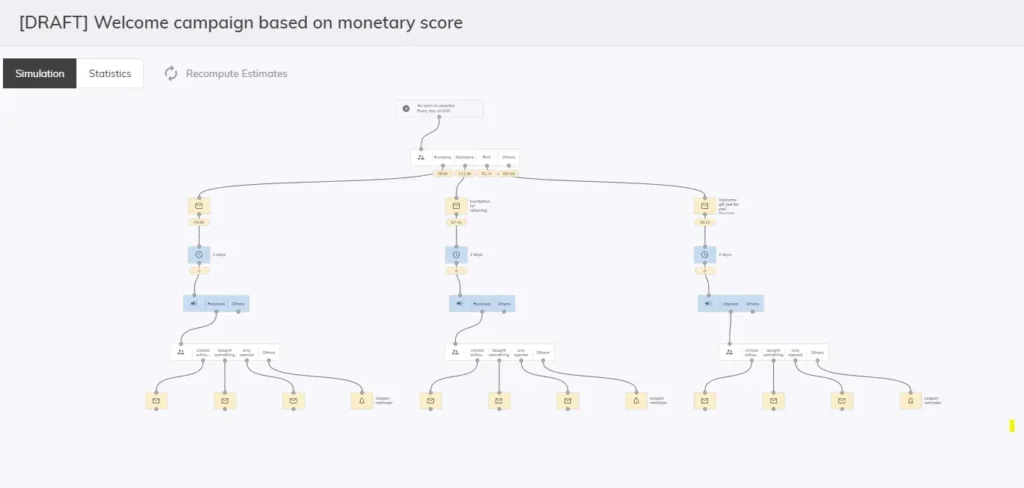
Creating a flow campaign
Samba Analytics offers you all the information you need to set up a flow campaign. An important aspect is the time delay – you can find the average time delay before a customer makes a second purchase. We usually recommend targeting your first-time customer a week before the predicted second purchase or after two weeks after their first purchase if you do not find the statistically ideal time to send them. In this campaign, we are going to send an email to all the customers that made only one purchase in the last 30 days.
You simply click on Flow campaigns from the main menu, fill in the name, activation, execution and targeting details. If you are not sure how to create this campaign, find comprehensive information here http://bit.ly/Flowcampaigns